✓
Targeted hazard reduction
We focus on limbs that threaten roofs, vehicles, fences, power service drops, and walkways, and keep the canopy balanced so you do not trade one hazard for another.
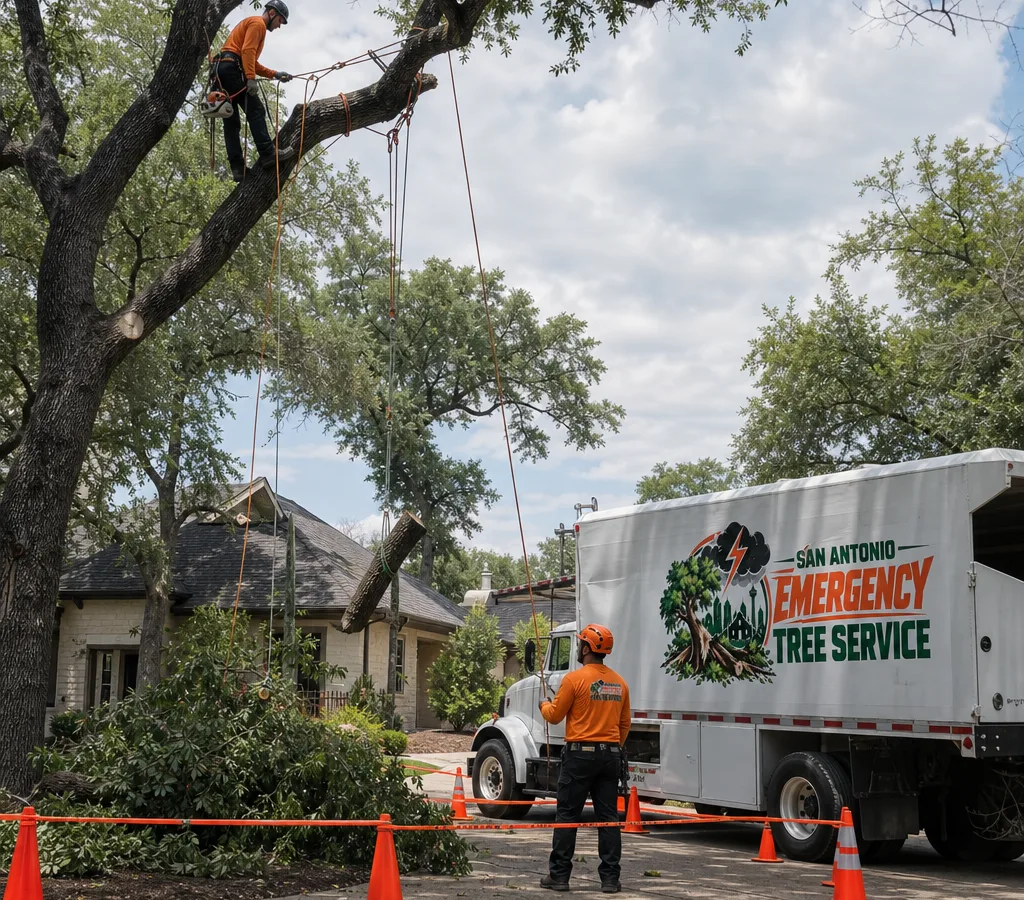
Tree pruning · San Antonio
Reduce storm risk, clear hazardous limbs, and keep your trees healthy with pruning that matches the species, the season, and what your property can safely support.
San Antonio tree pruning is part safety work, part plant health. After wind and heavy rain, trees often carry cracked unions, hanging branches, and partially torn limbs that can drop later, sometimes days after the storm when the wood finally gives.
Emergency Tree Service San Antonio prunes with two goals in mind: remove hazards without over-stripping the canopy, and guide future growth so the tree holds up better next time. That means making proper pruning cuts at the branch collar, reducing end weight on long laterals, and avoiding shortcuts like topping that create weak, fast regrowth.
If you are dealing with a tree that is already failing or leaning, removal may be the safer plan. Our team can talk through the options after an on-site look.
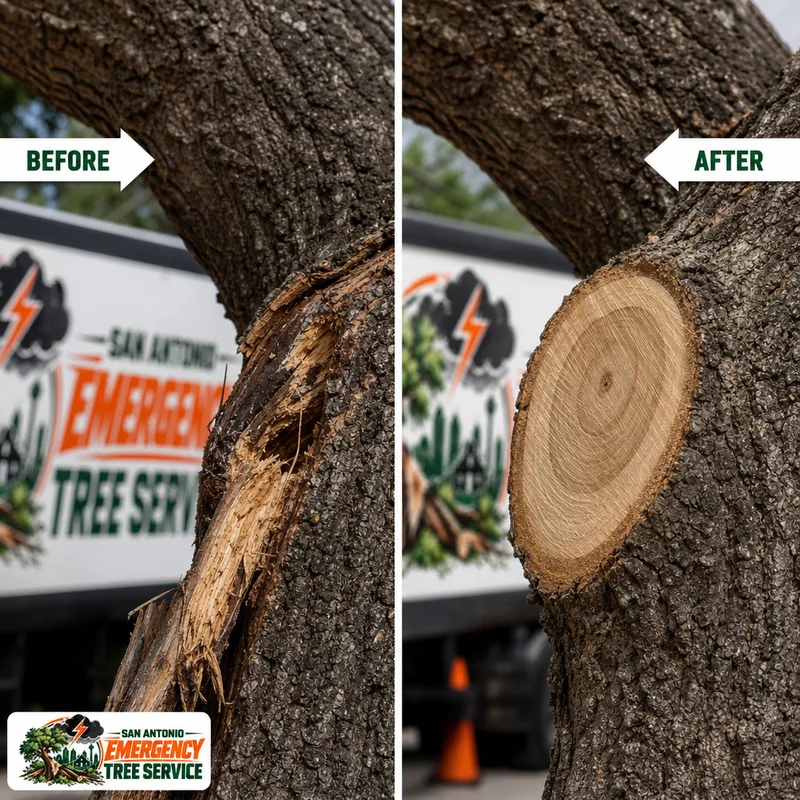
Recognize hidden storm damage
Not every broken limb is obvious from the ground. We look for damage patterns that commonly show up across San Antonio properties after wind events:
We also watch for bark tearing at the trunk. When a limb peels down the stem, the safest choice is often to remove the damaged branch cleanly and keep the wound as small as practical.
Complete, property-conscious work
We focus on limbs that threaten roofs, vehicles, fences, power service drops, and walkways, and keep the canopy balanced so you do not trade one hazard for another.
Young and mid-aged trees benefit from thinning competing leaders, correcting crossing branches, and reducing future weak attachments.
Selective removal of dead, broken, and rubbing branches helps reduce unexpected drop hazards and improves air movement through dense crowns.
We raise or reduce branches over driveways and pedestrian areas while keeping cuts sized and spaced for tree health.
When limbs are over a roofline or tight backyard, controlled lowering helps protect shingles, gutters, and landscaping.
Brush and limb debris is staged and removed as part of the job scope so your property is left usable after the work is done.
Pruning for South Texas properties
Pruning in San Antonio often comes down to access, nearby targets, and how trees grow in heat. In older neighborhoods like Alamo Heights, mature shade trees can extend over narrow driveways and close-set homes, so controlled rigging matters. In Stone Oak, landscaped backyards and multi-level roofs require careful planning for lowering and chipping wood without damaging hardscape.
Along the Rim and in areas with uneven grades, footing and equipment placement can limit what can be reached safely from the ground. Across the city, summer heat also stresses trees that have been over-thinned, so we avoid removing too much live canopy at once unless the tree is already compromised.
If a branch is contacting or tangled in overhead utility lines, keep people clear and let the utility provider address the line side of the hazard before pruning near energized conductors.
From assessment to clean yard
We walk the targets first—roof edges, service lines, gates, and driveway parking spots—then identify cracked unions, hangers, heavy end weight, and decay indicators.
You get a straightforward work plan describing what gets pruned, what gets removed, and how structures and landscaping will be protected.
We stage equipment, mark the drop zone, and set ropes or rigging before any major cut, especially when limbs are over a home or fence.
We prune back to appropriate laterals, avoid flush cuts, and manage weight in sections when needed so limbs come down under control.
We clear branches and brush per the agreed scope, then confirm canopy balance, clearance, and any follow-up recommendations for future pruning cycles.
Practical cost guidance
San Antonio tree pruning typically ranges from about $250 to $900 for routine pruning on one tree, while large, high-risk pruning over roofs or tight-access situations often runs $900 to $2,500+. Small deadwood cleanups are usually at the low end; storm-damaged limb removal with rigging, multiple cuts, and complex cleanup trends higher.
Price depends on tree size and species, how close limbs are to structures, whether rigging is required, and how debris is handled. Exact pricing is confirmed after an on-site assessment so the scope matches what the tree and property actually need.
San Antonio homeowner feedback
“After the storm we had a big limb hanging over the driveway. They explained what was cracked, took it down in pieces with ropes, and the tree still looks natural instead of hacked up.”
“We needed clearance off the roofline and patio without losing all the shade. The pruning was selective and the cleanup was thorough.”
Practical answers before work begins
For storm-related hazards like hangers and cracked limbs over a roof or driveway, we prioritize same-day or next-day scheduling when crews are available. Describe what is threatened and whether any limb is actively hanging or recently shifted.
If there is a safety hazard, prune immediately, even outside the ideal season. For non-urgent cleanup, waiting can be fine, but storm cracks and partially attached limbs tend to worsen with sun, wind, and repeat rain.
Correct pruning reduces failure risk by removing compromised wood and reducing leverage, but over-thinning or topping can do the opposite. We avoid stripping the canopy and aim for a natural crown shape the tree can support through heat and wind.
We do not recommend topping because it leaves large wounds and pushes weak, fast regrowth. When height is a concern, we look for reduction cuts back to suitable laterals or discuss whether removal and replacement planning is safer.
If branches contact or are entangled with overhead lines, the utility provider needs to address the energized line area first. We can handle pruning on the customer side where it is safe and legal to do so.
Keep people and pets away, move vehicles out of the drop zone if possible, and point out sprinklers, fragile landscaping, or gate-access issues. Do not try to pull down a hanging limb because tensioned wood can swing or snap unpredictably.
Debris handling is defined in the work scope, and most pruning projects include removal and staging so the property is usable when we leave. Keeping firewood or arranging on-site stacking can usually be planned when there is a safe placement area.
Safe pruning starts with a clear scope
Tell us what you are seeing, where the damaged branches are located, and what they could hit. We will recommend the safest pruning approach and provide a written scope that matches the tree and the property.